

Introducing something new in school can be an exciting process. There’s often a real sense of enthusiasm as colleagues come together, explore new approaches and begin thinking about how they might improve the experiences of students and staff.
Over the past few months, we’ve been working on strengthening our approaches to behaviour and emotional regulation across the school. This has involved staff training, shared resources and discussions about how we establish greater consistency in everyday practice.
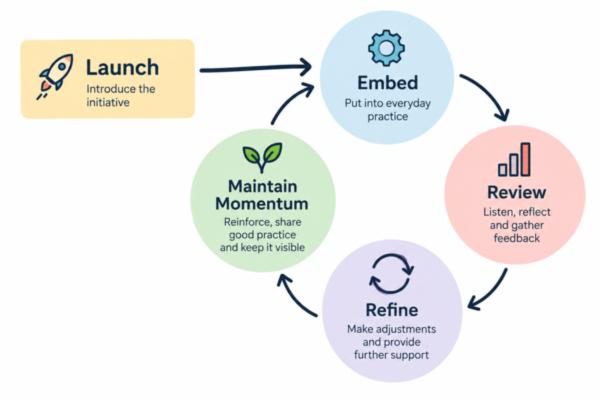
It’s been a useful opportunity to reflect on the process of introducing change, particularly what happens after the initial training and launch.
While getting something started is important, I’ve increasingly come to appreciate how much attention needs to go into supporting its development over the weeks and months that follow.
Establishing a shared understanding
One of the most important parts of introducing a new approach is making sure everyone understands what we’re trying to achieve and why.
This sounds relatively straightforward, but in a busy school, particularly one with different age groups and sections, establishing a shared understanding takes time.
Recently, we’ve been working on developing greater consistency in our approach to behaviour across the school, with a focus on establishing clear expectations and a common language that students and staff can recognise and use. Alongside this, we’ve introduced Zones of Regulation to provide a shared visual and language that helps students recognise and communicate their emotions.
Although these approaches serve different purposes, they share an important principle. Having a common understanding helps staff respond consistently while giving students greater clarity about what to expect.
Staff training and resources provide an important foundation, but the conversations that happen during and after implementation are equally valuable. Questions, different perspectives and practical examples can help colleagues develop a clearer understanding of how an approach works in their own setting.
Giving staff a voice
Something I’ve been thinking about is the importance of staff involvement beyond the initial training.
When introducing a whole school approach, there needs to be a degree of consistency. Otherwise, students can receive different messages depending on where they are or who they’re speaking to.
At the same time, staff bring different experiences, perspectives and professional judgement to their work. A teacher working with younger children may apply an approach differently from a colleague working with older students, even when the underlying expectations remain the same.
I think recognising this distinction is important.
Consistency doesn’t necessarily mean that every interaction needs to look identical. It’s about having a shared understanding of the principles and expectations, while allowing colleagues to respond appropriately to the students in front of them.
Creating opportunities for staff to share their experiences can also help identify what’s working well and where further clarification or support might be useful.
This is particularly valuable once an initiative moves beyond the training room and becomes part of everyday school life.
Maintaining momentum
The initial launch of an initiative often receives considerable attention. There may be training sessions, presentations, new resources and conversations across the school.
But maintaining that momentum requires a different kind of attention.
In my experience, it’s often the smaller, regular interactions that help reinforce a shared approach. Conversations with colleagues, revisiting expectations during meetings, sharing examples of good practice and making time to listen to feedback can all contribute.
Leadership visibility is important here too. When leaders are present around school, they have opportunities to see approaches being used, recognise positive practice and understand where colleagues might benefit from additional support.
It’s also worth recognising that embedding change takes time. Staff are balancing many different responsibilities, and introducing something new means finding ways to incorporate it into existing routines.
With Zones of Regulation, for example, we’re looking at how the approach can be further integrated into our PSHE curriculum and how parent workshops might help establish a shared language between school and home.
These are further steps in the process rather than separate initiatives, helping to reinforce what has already been introduced.
A final reflection
One of the challenges of school leadership is balancing the desire to introduce improvements with the time and attention needed to embed them properly.
Schools are constantly evolving, and there will always be new approaches, priorities and opportunities to consider. But introducing something new is only one part of the process.
I’m increasingly interested in how we create the conditions for initiatives to develop beyond their initial launch, particularly through staff involvement, ongoing conversations and a willingness to listen and refine our approach.
Perhaps one of the most valuable things we can do after introducing something new is to keep returning to it, giving colleagues the time, support and opportunity to make it part of everyday practice.