
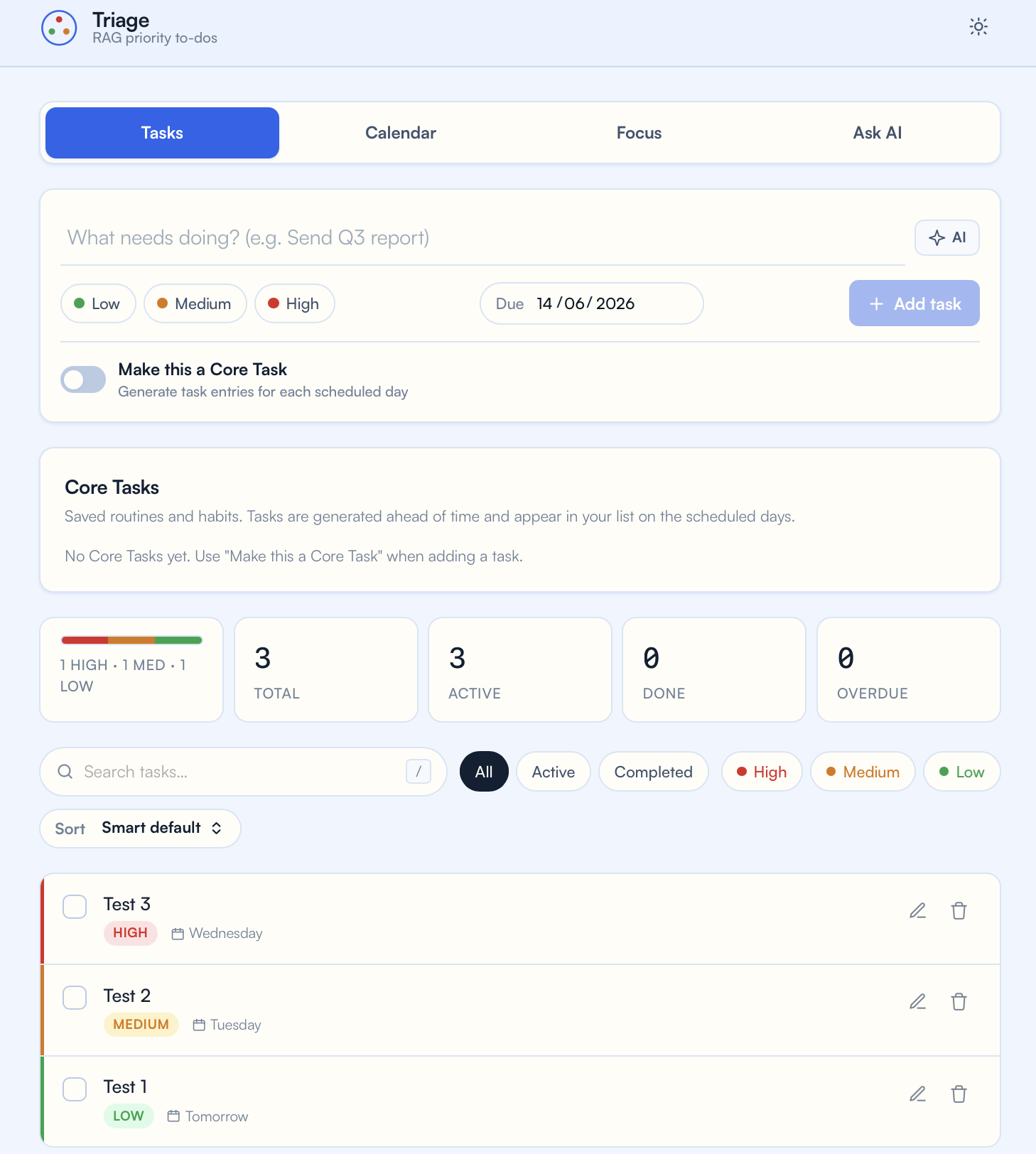
A while ago I wrote about Triage, a small private planning tool I built using AI. Since then it has changed quite a bit, and using it has taught me more about my own working habits than I expected.
The first change was removing something. The calendar originally had a notes section attached to each day, which felt like a useful idea at the time. In practice I never used it. I kept reaching for my notebook during meetings instead, and the digital notes area just sat empty. Removing it was a small thing, but it reminded me that not every feature that sounds useful actually earns its place. Sometimes the most useful update is taking something away.
A few additions have made more of a difference. There is now an Ask AI feature that can look across my task list and offer a daily briefing, suggest what to focus on, break larger tasks into smaller steps, review anything overdue, or suggest changes to how things are organised. I have also added a focus feature that helps set priorities for the week, and a view that places each task within the Eisenhower Matrix based on date and priority. Tasks are assigned automatically but can be adjusted manually, which feels important. The categorisation is a starting point, not a verdict.
Perhaps the change that has settled in most naturally is something called core tasks, which replaced an earlier scheduled tasks option. These are the recurring, routine tasks that come with the role, the kind of things that are easy to forget precisely because they happen so often.
What I have noticed most is how the simplicity of the morning routine has shaped my use of it. Reviewing the day’s tasks first thing, then reflecting later by ticking things off, has become a small but steady rhythm. It is not dramatic, but it is consistent, and that consistency seems to matter more than any individual feature.
Trying this for yourself
If any of this sounds interesting to you, it does not need to start with anything ambitious. The starting point I would suggest is simply noticing where your current tools fall short. Not in a vague sense, but specific moments. The feature you reach for that is not there, or the one that gets in the way every time.
From there, a clear idea matters more than technical knowledge. I started with a fairly simple prompt describing what I wanted, and the tool itself, including its name, came from that conversation. The early version will not be perfect, and that is fine. The value comes from using it for a while, noticing what works and what does not, then going back and refining it. Small adjustments tend to add up to something that fits far better than anything off the shelf.
It is also worth being honest about where this approach has limits. A personal planning tool is one thing. Anything that touches sensitive data, multiple users, or core school systems needs proper consideration around security, data protection, and oversight, which is part of why the earlier point about IT skills matters. But for individual, low stakes tools, the barrier to trying something is lower than it might seem.
This has made me think more broadly about other areas in a school that might benefit from small, customisable tools built around how people actually work, hosted within systems we already have. It also raises a wider question about SaaS, or software as a service, as a whole. There may be a case for schools to start thinking about developing the skills within their IT teams to connect data from the MIS to smaller, custom built tools. AI makes that kind of in-house development far more accessible than it used to be, though we could quickly become too reliant on it. At the same time, I keep coming back to the same principle: keep the expert, the human, at the core, and shape the system around them, rather than the other way round.